

Quick Answer
Blueprint estimating services convert architectural and engineering drawings into detailed, line-item cost estimates by measuring quantities, pricing materials and labor, and packaging the numbers into a bid-ready proposal. A skilled estimator can turn a full set of construction drawings into an accurate bid in as little as 24 to 72 hours, depending on project size and complexity.
That’s the short version. Now let’s walk through exactly how the process works, why it matters, and what separates a reliable estimate from a risky guess.
Why Blueprint Estimating Services Matter More Than Ever
Construction margins are thin. A single miscalculated quantity or missed line item can turn a profitable job into a money-losing one. That’s the reality contractors face on nearly every bid.

Blueprint estimating services exist to remove that guesswork. Instead of eyeballing a set of drawings or relying on rough rules of thumb, professional estimators use structured takeoff methods, current pricing data, and proven software to produce numbers you can actually trust.
For general contractors, subcontractors, and developers alike, the difference between winning work profitably and winning it at a loss often comes down to one thing: how accurate the original estimate was.
What Blueprint Estimating Services Actually Involve
A blueprint estimate isn’t a single step. It’s a sequence of careful, methodical stages, each one building toward a final number that reflects real-world costs.
1. Drawing Review and Scope Analysis
Every project starts with a full review of the architectural, structural, mechanical, electrical, and plumbing drawings. Estimators read plan notes, specifications, and addenda closely, because a missed detail on page 47 can throw off an entire bid.
At this stage, the goal is simple: understand exactly what’s being built before counting anything.
2. Quantity Takeoff
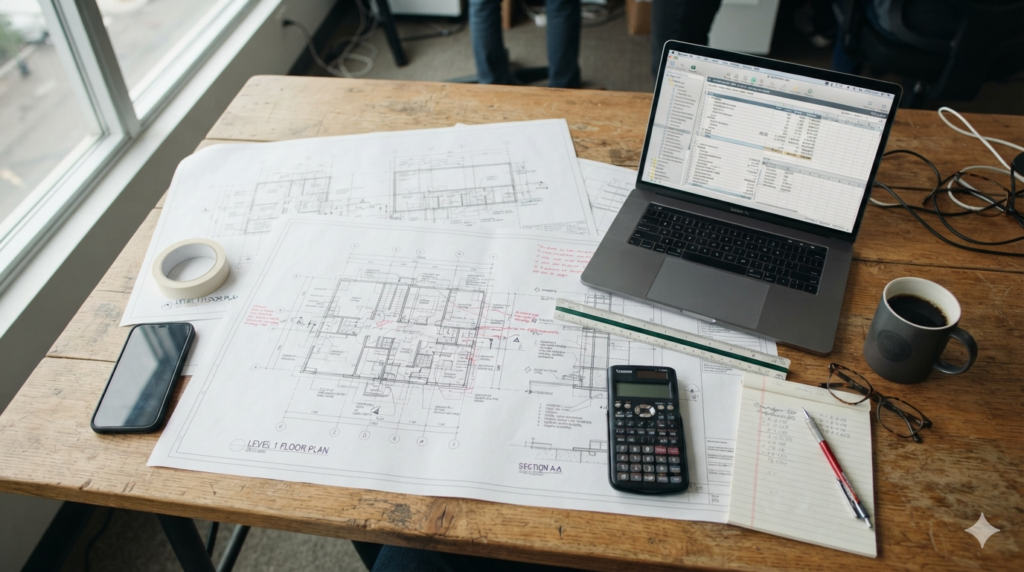
This is the heart of blueprint estimating. Using digital takeoff software, estimators measure every relevant quantity from the drawings, including:

- Square footage of flooring, roofing, and drywall
- Linear footage of framing, piping, and conduit
- Counts of doors, windows, fixtures, and fittings
- Volumes of concrete, aggregate, and other bulk materials
Consequently, accuracy here directly determines accuracy everywhere else in the bid.
3. Cost Application
Once quantities are locked in, estimators apply current material costs, labor rates, and equipment charges. Because prices fluctuate constantly, reputable estimating services rely on updated regional cost databases rather than outdated averages.

4. Markup, Overhead, and Contingency
Raw material and labor costs alone don’t make a bid. Estimators layer in overhead, profit margin, and contingency for risk, so the final number reflects a realistic, sustainable price rather than a bare-bones cost.
5. Final Bid Package
Finally, everything is organized into a clean, itemized proposal — often broken down by CSI division — so contractors can review it, adjust it if needed, and submit it with confidence.
Manual Estimating vs. Professional Blueprint Estimating Services
| Factor | Manual/In-House Estimating | Professional Blueprint Estimating Services |
|---|---|---|
| Turnaround time | Days to weeks | Often 24–72 hours |
| Accuracy | Varies by experience | Consistently high, software-verified |
| Cost data | Frequently outdated | Updated regional pricing |
| Software used | Spreadsheets, manual counts | Advanced takeoff platforms |
| Scalability | Limited by staff availability | Handles multiple bids simultaneously |
| Risk of missed items | Higher | Lower, due to systematic review |

As the table shows, the biggest advantage isn’t just speed. It’s consistency. Outsourced estimators aren’t distracted by field issues or project management duties; estimating is their sole focus.
A Practical Example
Imagine a general contractor bidding on a 15,000-square-foot commercial build-out. In-house, the project manager might spend three or four days squeezing in takeoffs between site visits and calls, and the resulting estimate is often rushed.
By comparison, a dedicated blueprint estimating service reviews the same drawing set, performs a complete digital takeoff, applies current regional pricing, and delivers a full bid package within two to three days — without pulling anyone off active jobs. The contractor still reviews and finalizes the number, but the heavy lifting is already done accurately.
That time saved often becomes the difference between submitting a bid before the deadline and missing the opportunity entirely.
Expert Tips for Getting the Most Accurate Estimate
- Send complete drawing sets. Missing pages or outdated revisions are the number one cause of inaccurate estimates.
- Include specifications and addenda. Specs often contain material grades and installation requirements that change pricing significantly.
- Clarify scope early. If certain trades are excluded, say so upfront to avoid a bloated or misleading number.
- Ask about regional pricing. Labor and material costs vary widely by location, so confirm your estimator uses local data.
- Request a line-item breakdown. A detailed breakdown makes it easier to spot errors and negotiate with subcontractors later.
Common Mistakes That Lead to Inaccurate Bids
Even experienced teams fall into predictable traps. Understanding these upfront helps you avoid costly surprises later:
- Relying on square-footage shortcuts instead of full takeoffs
- Using stale pricing data from previous quarters or years
- Forgetting soft costs like permits, mobilization, or waste disposal
- Failing to account for site conditions that affect labor productivity
- Skipping a second review pass before submitting the final bid

Why Outsourcing Blueprint Estimating Services Makes Business Sense
Hiring an in-house estimator is expensive: salary, software licenses, training, and ongoing pricing updates all add up. For many contractors, especially small to mid-sized ones, outsourcing blueprint estimating services delivers the same expertise without the fixed overhead.
Moreover, outsourced teams typically bid on a wide variety of project types, which means they’ve already seen the pricing quirks and pitfalls specific to your trade. That experience translates directly into fewer errors and faster turnarounds for you.
Conclusion: Turn Every Drawing Into a Winning Bid
At the end of the day, a bid is only as strong as the estimate behind it. Blueprint estimating services take the uncertainty out of pricing by combining careful drawing analysis, precise quantity takeoffs, and up-to-date cost data into one reliable package.
Whether you’re a general contractor juggling multiple bids or a subcontractor trying to win more profitable work, accurate estimating isn’t optional anymore — it’s the foundation of a healthy business.
Ready to turn your next set of drawings into an accurate, bid-ready estimate? Contact our team today and see how fast, precise blueprint estimating services can help you win more work — without the guesswork.
Frequently Asked Questions
What are blueprint estimating services?
Blueprint estimating services convert construction drawings into detailed cost estimates by measuring quantities, applying current material and labor pricing, and organizing everything into a bid-ready proposal.
How long does it take to get a blueprint estimate?
Most professional services deliver estimates within 24 to 72 hours, depending on project size, complexity, and the completeness of the drawing set provided.
How accurate are professional blueprint estimates?
When based on complete drawings and current regional pricing, professional estimates are typically accurate within a small margin, often noted as 90–95% precision before final bid adjustments.
What software do blueprint estimating services use?
Estimators commonly use digital takeoff platforms that allow precise on-screen measurement of quantities directly from PDF or CAD drawing files.
Do I need complete drawings to get an estimate?
Complete drawings produce the most accurate results, though many services can work from partial sets or conceptual drawings for preliminary budget estimates.
How much do blueprint estimating services cost?
Pricing varies by project size and scope, but many services charge a flat fee per project or a percentage of the estimated construction cost.
Can blueprint estimating services help subcontractors, not just general contractors?
Yes, subcontractors across trades like electrical, plumbing, HVAC, and concrete regularly use these services to prepare accurate, competitive bids.
What’s the difference between a takeoff and an estimate?
A takeoff measures quantities from the drawings, while an estimate applies pricing, labor, overhead, and markup to those quantities to produce a final bid number.
Why do bids vary so much between estimators?
Variance usually comes from differences in pricing data, missed scope items, or inconsistent takeoff methods, which is why using an experienced, methodical service matters.
Is outsourcing estimating cheaper than hiring in-house?
For most small to mid-sized contractors, outsourcing is more cost-effective since it avoids the salary, software, and training costs of a full-time estimator.


