

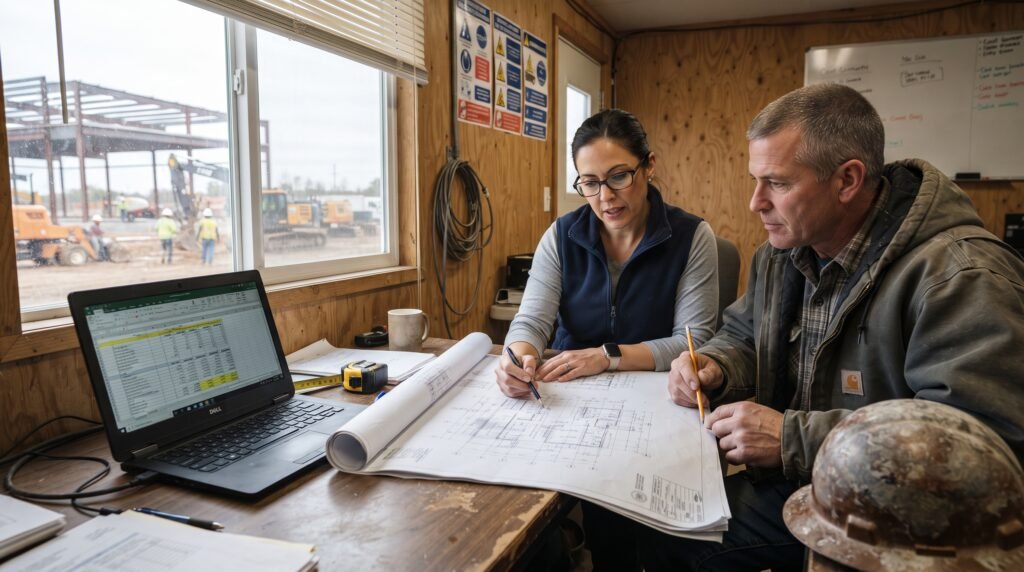
Bring in a construction estimating consultant when a project’s scope, timeline, or complexity outpaces what your internal team can accurately price on its own. That usually shows up in a few specific moments: a bid deadline that’s too tight for your current staff, a project type outside your normal wheelhouse, or a job large enough that a pricing mistake could threaten the whole contract.
Most contractors don’t think about hiring outside estimating help until they’re already behind. By then, the options are limited and the pressure is high. Understanding the signs earlier gives you room to make a better decision instead of a rushed one.
What Does a Construction Estimating Consultant Actually Do?
A construction estimating consultant provides project-specific cost estimating support — takeoffs, pricing, bid packages, and sometimes value engineering input — without becoming a permanent part of your payroll. Unlike a full-time hire, a consultant is brought in for a defined scope: one project, one bid cycle, or a short stretch during a busy season.
This makes the role fundamentally different from a retained or in-house estimator. A consultant is there to solve a specific problem, then step back once the job is priced.
Signs You Need One on a Project
Your internal estimator is stretched across too many bids at once. Accuracy tends to drop when one person is juggling five proposals with overlapping deadlines. A second set of eyes, even temporarily, catches things a rushed estimator might miss.

The project falls outside your typical scope. A residential contractor bidding on a light commercial build, or a general contractor pricing specialty mechanical work, benefits from someone who’s estimated that exact type of project before.
The bid deadline is tighter than your normal process allows. Some opportunities come with short turnaround windows. A consultant who can start immediately, without onboarding delays, often makes the difference between submitting on time and missing the window entirely.
The project size carries real financial risk. Larger contracts amplify the cost of an estimating error. Bringing in a specialist to review or build the estimate adds a layer of protection that’s hard to put a price on until something goes wrong without it.
You’re entering a new market or region. Material costs, labor rates, and permitting requirements shift by location. A consultant familiar with that specific market can flag pricing gaps a team unfamiliar with the area might overlook.
Consultant vs. In-House Estimator: Quick Comparison
| Factor | In-House Estimator | Estimating Consultant |
|---|---|---|
| Commitment | Ongoing, full-time role | Project-based or short-term |
| Best suited for | Steady, predictable bid volume | Spikes in workload or specialty projects |
| Onboarding time | Longer (hiring, training) | Minimal — brought in for a defined task |
| Cost structure | Salary and benefits | Project fee or hourly rate |
| Familiarity with your company | Deep, built over time | Limited, but often trade-specific expertise |
How to Bring a Consultant Into a Project Without Slowing Things Down

- Define the scope clearly before reaching out. Know whether you need a full estimate, a second review of an existing one, or takeoff support only.
- Share your plans and specs early. Consultants work faster when they receive complete documentation upfront instead of piecing it together mid-project.
- Set a firm deadline and communicate it immediately. Estimating consultants often manage multiple engagements, so clarity on timing helps them prioritize your project correctly.
- Assign one point of contact. Routing questions through a single project manager avoids the delays that come from scattered communication.
- Review the estimate together before submission. Even an experienced consultant benefits from a final conversation with your team about assumptions, exclusions, and local pricing quirks.
Common Mistakes When Working With an Estimating Consultant

A frequent misstep is bringing a consultant in too late — after internal deadlines have already slipped. That compresses their timeline and increases the chance of errors born from rushing.
Another mistake is withholding project details out of habit or caution. A consultant can only price what they can see. Incomplete drawings or vague scope documents lead to estimates full of assumptions, which then need revision later.
Some companies also treat the consultant’s estimate as final without an internal review. Even a skilled outside estimator doesn’t know your company’s specific margin targets or risk tolerance unless you tell them directly.
Expert Tips for Getting Accurate Results
Share your win/loss history on similar bids, even informally. It gives a consultant context on what pricing actually wins work in your market, rather than just what’s technically accurate.
Ask for a breakdown by cost category rather than just a bottom-line number. A category-level estimate — labor, materials, equipment, subcontractor costs — makes it far easier to spot where a number looks off before you submit the bid.
If the project involves unfamiliar materials or systems, ask the consultant directly about lead times and price volatility. That single question often surfaces risks a generic estimate wouldn’t reveal.
When a Consultant Isn’t the Right Fit
If your company bids frequently and consistently, a one-off consultant becomes a repeated expense that might make less sense than a retained estimator or an in-house hire. Consultants work best for occasional spikes, specialty projects, or capacity gaps — not as a permanent estimating solution. Recognizing that distinction early saves money and avoids the inefficiency of constantly re-onboarding new people to your bidding process.
Frequently Asked Questions
What is a construction estimating consultant?
A construction estimating consultant is an outside professional hired to prepare or review cost estimates for a specific project or bid, typically without joining a company’s permanent staff.
How much does an estimating consultant typically cost?
Costs vary based on project size, complexity, and scope of work, and are usually structured as a flat project fee or an hourly rate rather than a salary. Exact pricing depends on the specific engagement.
When should I hire a consultant instead of using my in-house team?
Hire a consultant when your internal team is at capacity, the project falls outside your usual expertise, or the bid deadline is too tight for your normal process to handle accurately.
Can a consultant work with our existing takeoff software?
Most experienced consultants can work within common platforms like PlanSwift, Bluebeam Revu, or On-Screen Takeoff, though it’s worth confirming compatibility before starting the project.
Is hiring a consultant cheaper than hiring a full-time estimator?
For occasional or project-specific needs, yes, since you avoid salary and benefit costs. For companies bidding constantly, a full-time or retained estimator often becomes more cost-effective over time.
What information does a consultant need to start an estimate?
Complete architectural and engineering plans, project specifications, and any known scope exclusions or special conditions. The more complete the documentation, the more accurate the resulting estimate.
Do estimating consultants only work on large projects?
No. Consultants are used for projects of all sizes, though they’re especially valuable for large or unfamiliar projects where the cost of an inaccurate estimate is higher.
How quickly can a consultant start on a project?
Turnaround depends on the consultant’s current workload and the complexity of your project, but most can begin quickly since there’s no lengthy onboarding process involved.
What’s the difference between a consultant and a construction cost estimator on staff?
A staff estimator works exclusively for one company on an ongoing basis, while a consultant is engaged for a defined project or period and then moves on to other clients.
Should I use a consultant for every bid?
Not necessarily. Reserve consultants for projects that genuinely need extra expertise, capacity, or specialty knowledge, rather than using them as a substitute for building reliable internal estimating capacity.
Conclusion
Knowing when to bring in a construction estimating consultant comes down to recognizing capacity limits before they turn into missed deadlines or inaccurate bids. The contractors who use consultants well treat them as a targeted resource for specific projects, not a permanent fix for an understaffed estimating process. Used at the right moment, a consultant adds precision exactly where it’s needed most.
If you’re staring down a bid deadline that feels out of reach, or a project type your team hasn’t priced before, reach out to Amazee Estimation to talk through what your next bid actually needs.
External Authority Sources
- Associated General Contractors of America (AGC) — could support general statements about bidding practices and industry standards.
- American Society of Professional Estimators (ASPE) — could support claims about estimator qualifications, certifications, or professional standards.
- National Institute of Building Sciences (NIBS) — could support references to construction cost data standards and industry benchmarking practices.


