

Introduction
Every construction project starts with a number, and that number can make or break a contractor’s bottom line. However, not all estimates are created equal. In fact, residential construction estimating and commercial construction estimating operate under completely different rules, even though both aim to predict the same thing: how much a project will cost. Therefore, understanding these differences isn’t just useful, it’s essential for anyone bidding on projects, managing budgets, or trying to win more work in a competitive market.
Consequently, whether you’re a general contractor branching into commercial work for the first time, or a homebuilder curious about what separates your process from large-scale developers, this guide breaks down the key differences. Additionally, we’ll look at why accuracy matters more in one sector than the other, and how residential construction estimating requires a distinct approach compared to its commercial counterpart.

What Is Residential Construction Estimating?
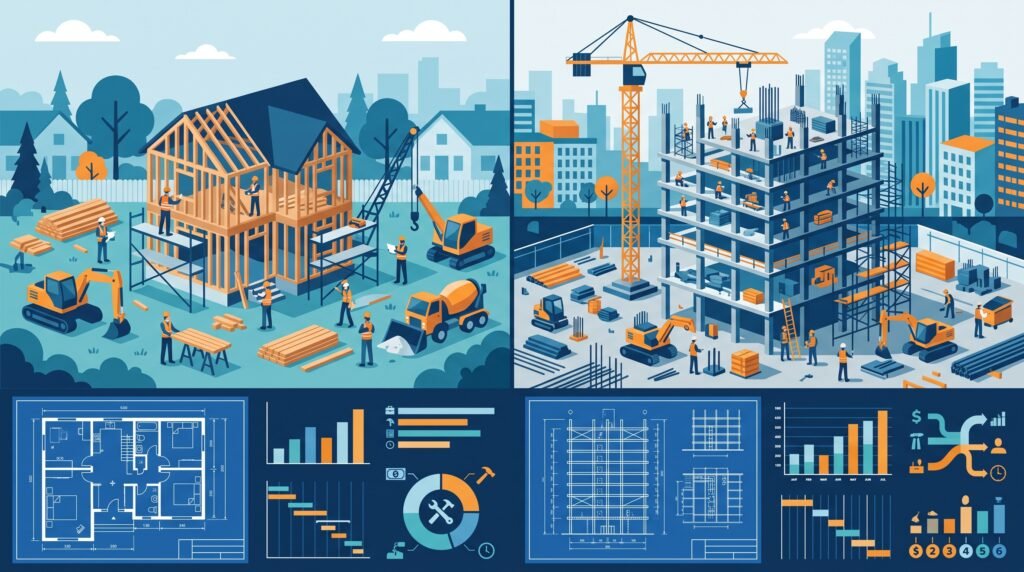
Residential construction estimating refers to calculating the total cost of building or renovating homes, townhouses, or small multi-family units. Generally, this includes materials, labor, permits, and site work for single-family homes or smaller residential developments.
Because residential projects are typically smaller in scope, estimators usually work with simpler blueprints and fewer stakeholders. As a result, the estimating process tends to move faster, and adjustments can be made more easily throughout the project lifecycle. Meanwhile, homeowners and small builders often expect quick turnaround times on quotes, which places pressure on estimators to balance speed with precision.
What Is Commercial Construction Estimating?
On the other hand, commercial construction estimating involves much larger and more complex projects, such as office buildings, retail centers, warehouses, schools, and hospitals. Since these projects involve multiple trades, extensive code compliance requirements, and larger budgets, the estimating process is significantly more detailed.
Furthermore, commercial estimators must account for structural engineering, HVAC systems, fire safety codes, ADA compliance, and often union labor rates. Consequently, the margin for error shrinks considerably, because even a small miscalculation can translate into thousands, or even millions, of dollars in cost overruns.

Key Differences Between Residential and Commercial Estimating
1. Project Scale and Complexity
To begin with, residential projects are generally smaller and more standardized. For instance, a typical single-family home follows familiar layouts and materials. In contrast, commercial buildings vary dramatically depending on their purpose, whether it’s a retail strip mall or a multi-story office tower. As a result, commercial estimators must adapt their approach for nearly every new project.
2. Level of Detail Required
Similarly, residential estimates often rely on square footage pricing or standardized cost-per-unit calculations. Meanwhile, commercial estimates demand line-by-line breakdowns of every trade, material, and labor hour. Because of this, commercial estimating typically requires specialized software and a deeper understanding of building codes.
3. Timeline and Turnaround
Additionally, residential estimates usually need to be delivered within days, since homeowners and small builders want fast answers. Conversely, commercial estimates can take weeks, especially for large-scale bids that require coordination between architects, engineers, and multiple subcontractors.
4. Regulatory and Code Compliance
Moreover, commercial construction is subject to stricter building codes, zoning laws, and safety regulations than most residential projects. Therefore, commercial estimators must factor in compliance costs that residential estimators rarely encounter, such as fire suppression systems or accessibility upgrades.
5. Labor and Material Costs
Also, labor rates differ significantly between the two sectors. Specifically, commercial projects often involve unionized labor and specialized trades, which typically comes at a premium. Meanwhile, residential labor costs tend to be more predictable and localized, since most residential contractors work with familiar subcontractor networks.
6. Risk and Contingency Planning
Not only that, but commercial projects also carry higher financial risk due to their scale. As a result, estimators usually build larger contingency buffers into commercial bids, whereas residential estimates often carry smaller margins because the stakes, and the dollar amounts, are comparatively lower.

Why Accuracy Matters More Than Ever
Regardless of project type, accurate estimating remains the foundation of profitable construction work. However, the consequences of inaccuracy differ. For residential builders, a slightly off estimate might mean a tighter profit margin. For commercial contractors, though, an inaccurate bid can mean losing a multi-million-dollar contract or absorbing unexpected costs that eat into profitability for months.
That said, both sectors benefit from leveraging professional estimating services rather than relying solely on in-house guesswork. In addition, using digital takeoff tools and historical cost data helps estimators of all types reduce errors and improve bid-win rates. According to industry data from the Associated General Contractors of America, construction costs continue to fluctuate due to material pricing and labor shortages, making precise estimating more important than ever.
Which Type of Estimating Is Right for Your Business?
Ultimately, the answer depends on your niche. If you specialize in home construction, remodels, or small residential developments, mastering residential construction estimating will serve you best. On the other hand, if you’re pursuing larger contracts with commercial developers, government entities, or institutional clients, investing in commercial estimating expertise, or partnering with a specialized estimating service, becomes essential.
Either way, outsourcing your estimating needs to professionals who understand these nuances can save time, reduce costly errors, and ultimately help you win more bids.
Frequently Asked Questions
What is the main difference between residential and commercial construction estimating? The main difference lies in scale and complexity. Residential estimating typically covers smaller, standardized projects like single-family homes, while commercial estimating involves larger, more complex buildings with stricter code requirements and multiple trades.
Is commercial construction estimating more expensive than residential? Generally, yes. Commercial estimating requires more detailed analysis, specialized software, and often higher labor costs due to union rates and regulatory compliance, which makes the estimating process itself more resource-intensive.
Can one estimator handle both residential and commercial projects? While some estimators work across both sectors, most specialize in one due to the differing skill sets, software requirements, and regulatory knowledge each type demands.
Why should I outsource my construction estimating? Outsourcing to a professional estimating service reduces errors, saves time, and provides access to specialized expertise, whether you’re bidding on a residential remodel or a large commercial build.
Final Thoughts
In conclusion, both residential and commercial construction estimating share the same core goal: predicting project costs as accurately as possible. However, the methods, timelines, and risks involved differ significantly. Therefore, understanding these key differences helps contractors, builders, and developers choose the right approach for their next project, and ultimately, win more profitable bids.